

Two stabilisers, one filmmaker, and a war scene
On mobility and getting close enough to matter

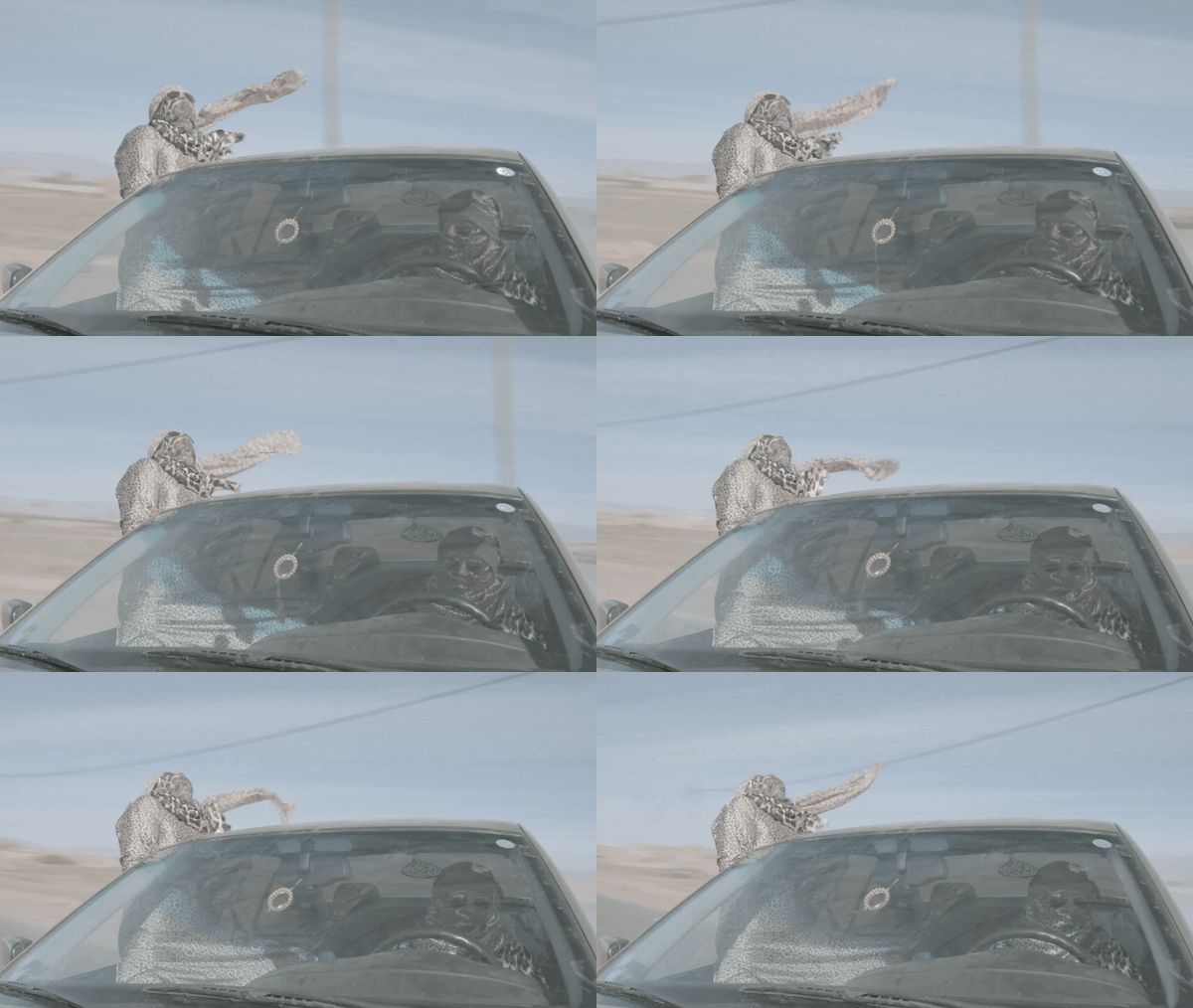
Increased mobility as a small team of filmmakers has been a core part of my trajectory. I find a similar arc when talking with artists working in music videos or dedicated DOPs for commercial shoots.
When reading, take into account that I am speaking from the perspective of an independent filmmaker. I usually work alone, or with a second person, and lucky if I have three. I hope to work with more people (do reach out if you want to work together). Because of this, I am always looking for ways to develop my arsenal for further enhancement of creativity, efficiency, and transportability. The latter is best solved with a car, but you can also do so with additional accessories.
The Orbit
With your camera you can show the event from emotional point of views by means of orbital camera movements, often the orbital movements itself cause the emotional point of view within an event while the filmmaker is a harmonious part of the event without interfering.
Single Shot Cinema: a different approach to film language
Recently, I have been toying with the idea of motion shots: Car shots - with the camera on the bonnet, or the camera looking through the passenger window; tracking shots - say tracking of a runner or a dancer; or shooting a whole war scene.
Notice the contraption, it looks like a tripod turned handheld with a stabiliser attachment holding the camera, or something close to it. This video came to me at exactly the right moment, when I was sitting with a decision between two different paths forward. Both would increase my mobility. Both are expensive, though film equipment is an absolute pocket-sore regardless. What struck me about this video, shot in Ethiopia, is how much it illustrates what mobility actually unlocks. Increased access. The ability to move with people, to follow them into their world. For a filmmaker working with a socially engaged lens, that’s not a technical upgrade; it’s the whole point.
I’ve been shooting dancers, and I keep running into the same wall. Dance demands motion, and a camera on a tripod can only repackage that as stillness for so long. Good handheld operation gets you somewhere, but I wanted more control over the shake and not just less of it.
A technique I’ve been using, without any rigs at all, is slow-motion as a stability tool. Shooting at 60fps on a 30fps timeline means the footage is stretched across twice the time, and the inherent jitter gets stretched with it. It’s a genuine trick. But it has a hard limit: what if the scene can’t be slow motion? What if there’s sound? Stretch the footage, and you stretch the audio with it, and that’s rarely recoverable. I needed something else.
What is an Easyrig?
An Easyrig is essentially a vest with a boom arm that runs over your shoulder, suspending the camera in front of you on a bungee-style cable. The weight transfers from your arms to your torso. That’s the whole idea. For a camera operator carrying a heavy setup all day, it’s the difference between functioning at hour eight and not. For me, working lighter, the appeal is slightly different as it’s about what it does to the image. When your arms aren’t fighting the weight, the camera floats. In an organic way and not the clunky precision of a non-human. The movement starts to resemble how the eye actually moves through space.
What is a Flycam?

A Flycam is a stabiliser, a handheld rig with a counterweight system below the camera that uses momentum and balance to iron out shake. Think of it as the mechanical predecessor to the gimbal. Just physics with the motors, almost like a plumb line in engineering. Getting it balanced correctly is its own craft, and operating one well takes real practice, but when it works, the footage has a quality that’s hard to replicate digitally. There’s a reason they were the industry standard for decades before gimbals arrived, and a reason some operators still prefer them. It’s funny as I write these words, now my walks down the street involve spotting who’s got the latest flycam or easyrig. The mind likes to reveal what it represents most visibly in your third eye.
What is a Gimbal?

A gimbal is a motorised stabiliser. Three axes of movement: pan, tilt, and roll. Each is controlled by a motor that counteracts any unintended motion in real time. Point it where you want, walk, run, turn, and the camera holds its position regardless of what your body is doing. The learning curve is shorter than a Flycam, the results are more consistent, and the footage has a specific look: glassy, smooth, almost frictionless. This is both its strength and its limitation. Sometimes you want a little friction. The biggest learning curve is more about the initial balancing act of the camera along the three axes. Once mastered, this machine quickly becomes a versatile tool. I used it recently for a Sudanese fundraiser where I was able to follow the movement of the children involved in the performance ceremonies.
What accessories can you get for a Gimbal?
This is where it gets interesting. The gimbal on its own is a tool for smooth horizontal movement, but pair it with the right accessories and the range of what you can achieve starts to expand significantly. A follow focus lets you pull focus remotely while the gimbal is in motion, something that’s almost impossible to do manually at the same time as operating. DJI Lidar Focus system takes this accessory to the next level, allowing precision sensitivity to the movement of the locked subject. This is ideal for cameras with dodgy auto focus, or even manual lenses, where external focus control is needed for extra oomph.
An external monitor means you’re not squinting at a small screen trying to frame a moving subject. For DJI, this can come in the form of the Transmission module. Extension poles let you drop the camera low to the ground or push it out over a space. And then there are mounting systems, car mounts, suction rigs, and clamps that take the camera off your body entirely and put it somewhere the shot demands.
What happens if you connect the two?
This is the question I kept circling back to. What if you mount the gimbal to an Easyrig instead of holding it freehand? On paper, it sounds redundant, two stabilisation systems doing the same job. But in practice, they solve different problems. The Easyrig removes weight and transfers fatigue. The gimbal removes shake and controls the axes. Together, you get a rig that can move through space for long periods, with a camera that stays locked regardless. For tracking a dancer, following someone through a crowd, or moving through a location continuously, it starts to open up shots that would otherwise require a dolly, a crane, or a crew three times the size. For a filmmaker working alone or nearly alone, that matters. There are examples of this
Affordability
I hate this reality. The equipment above will set you back a minimum of around £500, and comfortably up to £2000. Affordability is the biggest obstacle in filmmaking. It was built as an industry inside a money economy, which is why Hollywood only makes what returns a profit. For the small team, the only way through is smart decisions about when and how you spend.
Staggering purchases is the most common-sense approach. Buy a little today, a little tomorrow, and slowly the kit accumulates.
Renting is a reasonable solution, and one most filmmakers lean on at some point; it lets you access equipment without the upfront cost. But it adds weight to pre-production, delivery costs money, and if you’re working abroad or off the beaten track, finding rental stock gets complicated fast. You solve one problem and welcome several others.
The approach I’ve settled into is working with clients to acquire equipment on a project basis. As relationships with collaborators and clients deepen, and trust in the work builds, you gain leverage to have more ambitious conversations. A request to shoot a dance film becomes an opportunity to restructure the fee, part for your time, part toward the equipment the project actually needs. Some clients will cover the full cost, others offer a contribution. Either way, it’s a useful filter: the ones willing to invest in the tools are usually the ones who genuinely believe in what you’re making.
There’s also the option of buying outright. As a registered sole trader or limited company, equipment purchased for work is a legitimate business expense, deductible from your annual tax. The savings feel delayed, but it’s real, and it’s the most straightforward way to build a professional kit over time.
Affordable Alternativos

A fabric camera strap is the most versatile and cheapest mobility upgrade there is at around £15, and I’d recommend one even to someone running the latest motorised rig. It creates two points of contact between the camera and your body, distributing shake across the strap before it reaches the lens. You move more freely, swivel more naturally, though slow and controlled movement still matters.

The cine saddle sits in a different category. It’s a one-time purchase, around £300, sometimes less if you find a dupe on Alibaba. It looks like a glorified cushion, which is essentially what it is. The camera rests on top, the saddle hangs from a neck or shoulder strap, and the whole system distributes movement across a wide area. The stability is genuinely good. It can also function as a car mount through a longer strap stored in a hidden pocket. It folds flat, travels on a plane without issue, I’ve used mine as a pillow, and once you have it, you have it. No accessories, no recurring costs, no ecosystem to buy into. The main problem I’ve noticed is that a bigger camera can sink so deep into the cushion that you get a raised piece of fabric entering the frame, which is a problem specific to this product and not experienced anywhere else...ever.
With these notes, I hope you find time to gather your thoughts. No equipment is ever a waste, for even the regretful purchases teach us something, but let’s try to make a small plan, as there’s a lot to buy, especially if you want to shoot a war scene.
Further Reading
Equipment Listed
Easyrig
Flycam
Gimbal
Camera Strap
Cine Saddle