

I don't trust black men who ONLY date black women
Calling all Umar-lites and Agbo Jedi sorcerers!

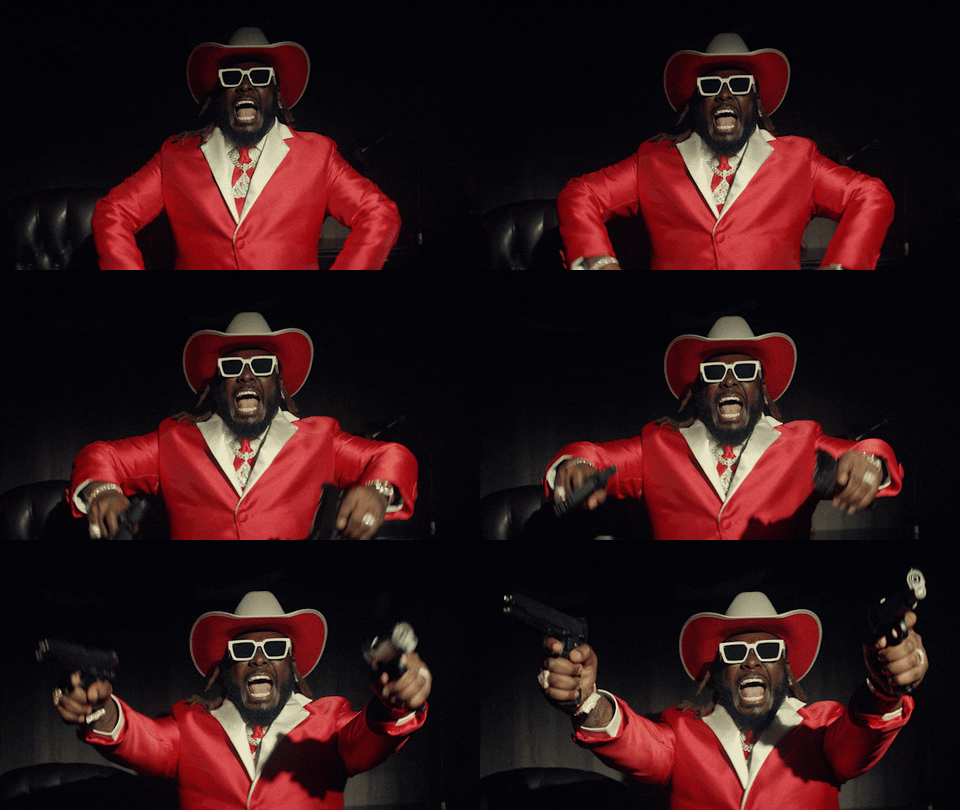
I don’t trust black men who say they only date black women because there’s a deep rooted truth that they’re running from. At what point did participation in black culture involve validating your commitment to black women through exclusive dating status. Let me say this once, this is NOT mantra calling out all black on black dating to stop. Forgive me if I have led you down the wrong path.
This is a vehement rejection of the insurrection of black men cosplaying as knights in obsidian armour to save the black women. First of all, black women do not need to be saved. yes, create space and encourage their greatness, but that’s just it - encourage what already exists. The black men i’ve met who exclusively date black women, have this diatribe to blackness defined as a hyper-participation in stereotypical black traits. Having the local Jamaican wine pon yu cocky at the blocky part-y, hitting every note on hot wuk just so they can return to the squad on high-alert as they break bread on who’s backoff got bruk up fastest.
If a man tells me that they ONLY date black women, I wonder what has brought you to this conclusion? Are you dating the woman because she’s black? Are you trying to prove allyship? If a black man tells me that they ONLY date women, I wonder what hurt you? Are you trying to prove your blackness? I beg you tell me her name? Why is she this mythical black figure in your recollections? These Men who only date black women arbitrarily hold ‘blackness’ as the highest good which really is just the neighbouring cousin of white supremacy. In fact, if a white man said he only dates white women - where would that leave us? It would make race a sufficient and necessary condition for worth. It would turn white skin into marble, and it would reupholster the black fantasy into onyx - and this is precisely the feature I’m diagnosing in black men who exclusively date black women. It is true, there can be a genuinely stark difference between in-group preferences for black people and white. Where one group is born from a history of marginalisation, the other into one of dominance. The asymmetry holds and in this case, I concede. Which means that I am not interested in diagnosing a preference, I am more focused on the architecture beneath it, where race is used a mechanism to drive intimacy, when in fact history and character should be the driving force.
The history of racism runs thick but the trauma in these men runs deeper. I meet black women all the time, I won’t simply fall in love because of her skin colour - perhaps her personality, or interests, or even beauty might sway me. But to limit her condition to the colour of her skin presents two major concerns to me. The first is a Fanonian inversion. In Black Skin, White Masks, Fanon diagnosed the colonial subject’s crisis as one of alienation. The black man forced to wear a white mask over his black skin, to trade his selfhood for legibility within a white world. What these men perform is the mirror image: a black mask pulled over white desire. The objet petit a of ‘supreme blackness’. This claim to cultural capital dictated by race relations is a structure that yearns for racial validation, the need to prove belonging through intimate life. This I am forced to point out is the colonial psyche, still organised around race as the supreme arbiter of worth. Fanon’s patient has not been cured. And if Fanon’s readings hold true, then the colonised repeat the mindset of the coloniser without the coloniser ever being present. In my own practice, I have always known of the connection of sculpture and cinema, where the mask that clouded the judgement of the black child, left in schism and shock after losing status, today reasserts a new mask. A statue. An idea. A wail masquerading as ‘blackness’.
The second concern is the hierarchy it insidiously installs. It presupposes the black man’s identity as a man first, his blackness second, a complexity he extends to himself without hesitation, while collapsing the black woman into her blackness entirely, whilst her womanhood becomes an afterthought. His inferiority vis-a-vis her symbolism. In this arrangement the only victor is the black man, now living the domestic dream of the very system he claims to resist: one race; one household; one Black People’s Republic of...well you get it by now. The white patriarch’s fantasy, reupholstered in onyx.
AlI of them endowed the Negro with powers that other [wo]men (wifes, transient lovers) did not have.
p.158 Black Skin, White Masks
Now, of course, some of you will consider the cultural pollination present in the practical sense of dating within your race. I’m not challenging that view. Instead, I am more focused on the hyper-fixation on blackness present in asserting the claim that “I as a black man only date black women”, you might say that “you find more common ground with women from Nigerian backgrounds” or “I love a girl I can share my coconut oil with”. In this light, the cultural alignment is clear. But in the other view, of only dating black women, you would be inclined to ignore the scope of dating a Ghanaian women of white complexion. Which happens in this world. In that instance, I smack a sucker in the face, grabbing them by the collar, yelling to what end. To what end on earth will you travel to prove your blackness to the world. These men are hurting. Deep down inside. I see the pain. I extend my hand, but not before the pen which I use to slander such occurrence. For you blackness is not defined by who you date. Nor need it be announced in the eye you cast to other black people that refuse to be categorised according to this knowledge system. In this view, I reject the need to impose identity over universal behaviour. And so I don’t trust black men who only date black women, because they haven’t learned to trust in themselves yet. They haven’t learned to explore the world beyond blackness, falling for the capitalist strategy of race segregation and class isolation.
Regardless of the architecture I’ve described, in-group dating can serve a function that is genuinely reparative, a form of protection from a world that already casts racialised bodies aside. That phenomenon is not the equivalent, or the antithesis, of what I’ve been diagnosing, and it isn’t something I mean to discourage. It sits outside my critique entirely. What I am describing is narrower: not the black man who loves black women, but the black man who leads with an announcement of that love as a totalising identity claim, proof of belonging to a category of people he knows only by their race. That is a man, I think, still caught in the schisms of race politics, and he is due some healing.