

Advertising grammar of colonial cinema
Films for Primitive People

There is something that has always troubled me about the phrase public broadcasting. Public, as in for the people. Broadcasting, as in sending a signal outward. But a signal always carries content. And content always carries a point of view. For some time, the empire was televised.
The BBC banned advertising from day one. John Reith, its first director general, saw that as a point of principle. Commercial television, in his view, corrupted the relationship between broadcaster and audience; it introduced a third party, the advertiser, whose interests would always distort the message. Public money, he argued, should be tied to inherent ethical values: inform, educate, entertain. A clinical approach.
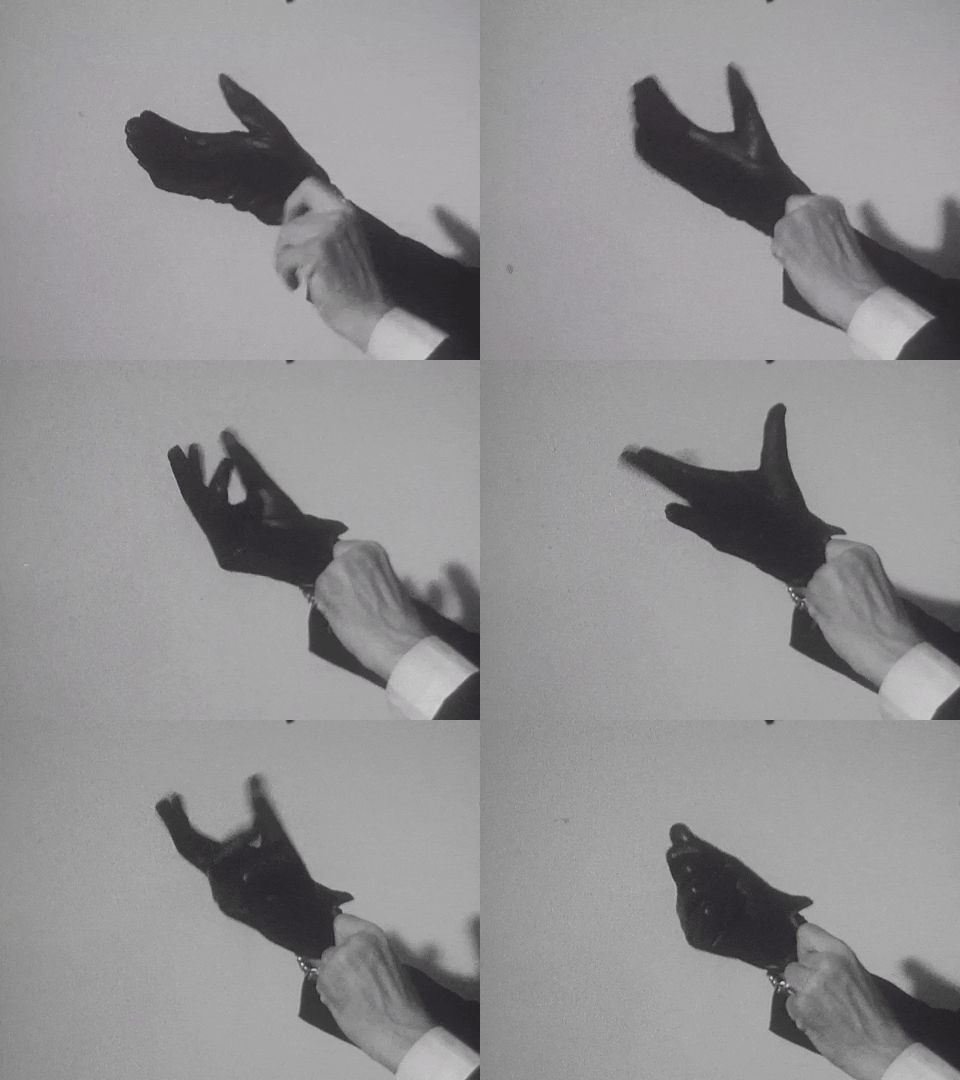
What Reith understood, and what I think he counted on, is that a space framed as free from commerce is a space where ideology can travel without being identified as ideology. No one is selling you anything. This is simply the truth of the world.
To understand how this worked in practice, we need to go back to 1933 and the General Post Office.
The GPO was, at that point, the largest employer in Britain. It was responsible for building the country’s national communications infrastructure. Comms points like telephone lines and postal networks. And in 1933, it established a Film Unit, housed inside its Public Relations department.
A film unit. Inside a PR department.
The films the GPO produced, including the celebrated Night Mail (1936), were presented to audiences as documentaries. They were screened in cinemas, in schools, and later on television as factual programming. But they were funded by a government institution, shaped by public relations objectives, and designed to build goodwill. John Grierson, often credited as the father of British documentary, built his entire career within this model. He did not see a contradiction in that. He believed film could serve democratic public life precisely by working within institutions. His legacy continues today through the Grierson Award, which annually recognises the best in documentary filmmaking.
The sponsored documentary model was made to promote a version of the world. That’s the first layer of what I am calling advertising grammar.
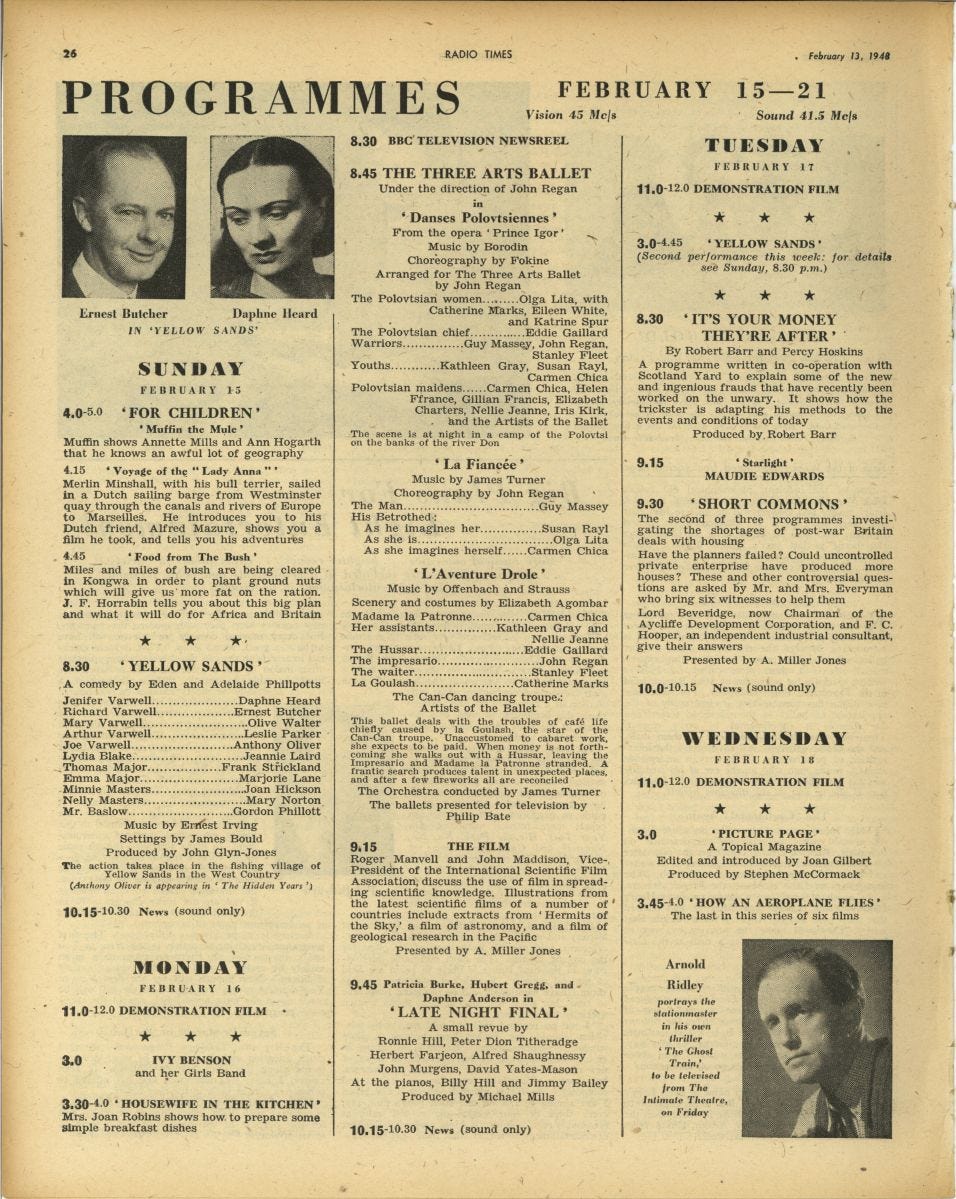
Look for 9.15 in the image below, which showcases the impetus for the use of film in spreading scientific knowledge.
From 1939 to 1955, the Colonial Film Unit operated directly out of the Colonial Office’s PR department, sharing workforce and equipment with the GPO Film Unit. The institutional continuity was a coordinated apparatus of public communication, and the CFU was its most revealing arm.
The CFU produced films in two directions simultaneously:
Films made for colonial subjects: promoting hygiene, loyalty to the Crown, and compliance with British authority.
Films that circulated back to Britain: packaging Nigeria, the Gold Coast, Kenya for domestic audiences. Empire rendered as orderly, productive, and grateful for the arrangement.
This dual circulation is worth sitting with. The same institution was selling the idea of empire to the colonised and to the colonisers at the same time. Different audiences, same grammar.
In 1940, a film called Mr English at Home was produced by the CFU under the direction of William Sellers. It became a template from which to model everything else that the CFU would make afterwards. Sellers would later appear on the BBC to discuss the directorial vision behind it, screening sequences from the film’s opening moments.
What the opening establishes is a deliberately slow, stripped-back visual language. Static shots held far longer than any British audience would expect. Minimal camera movement. Simple compositions. No cross-cutting, no tricks, no ellipsis. Fades between scenes, but nothing that might disorient a viewer unfamiliar with cinematic convention.
The CFU’s own internal report from East Africa justified this approach in language that is worth reading carefully:
“The characters are few and the scenes remain on the screen sufficiently long for the native to appreciate their meaning.”
Tim Rice, Films for the Colonies, 2019 — Film Rules: The Governing Principles of the Colonial Film Unit
Read that sentence again. Sufficiently long for the native to appreciate their meaning. This theory of the audience assumes the inferiority of its viewers and builds an entire production methodology around that assumption.
By positioning African audiences as requiring special visual tutelage. The CFU justified its own existence as a specialist institution, and the continuation of British imperial authority during a period of war and civil uprising. The film grammar was the argument for the empire.
Sellers eventually formalised this into a set of governing principles for all CFU productions. They are worth reading in full, because they are extraordinary documents:
The general tempo must be slow, and the length of individual scenes must be twice or three times as long as is usually considered necessary for English school audiences.
The content of any given scene must be very simple in its composition, because natives view all objects on the screen with equal interest, unless the important object is clearly emphasised. Close and mid shots are therefore preferable to long shots.
Strict accuracy is vital in portraying native habits and customs. Mistakes at once turn a serious film into a comedy.
No camera tricks of any sort. Continuity must be clearly maintained in all changes of scene, even if it means using three shots where one would normally do for audiences more used to film technique.
Films must be made as silent. A master commentary is then written, and is added by a native commentator, or by disc records, through a microphone during each performance. This system is vital, owing to the great variation in local dialects.
What strikes me every time I read these rules is how they reveal the filmmaker’s gaze more than anything about their supposed audience. The assumption running through every point is that the people on screen, and the people watching, are pre-modern, pre-literate, and in need of management. The rules do not exist to make better films. They exist to produce a particular kind of spectator: one trained to receive a message without questioning its source.
At the start of this essay, I said the BBC created a neutral space where ideology could travel undetected. I want to make that concrete now.
Advertising does three things. It creates desire. It manufactures legitimacy. And it works emotionally, it does not argue with you, it makes you feel something before you have had the chance to think.
Run the CFU films through that framework.
Creating desire. Wide landscape shots of Nigerian plains. Voiceover narration describing progress, development, and modernity arriving. Empire is rendered as beautiful and inevitable. You are not being asked to want this. You are simply being shown a world in which it already exists and functions well.
Manufacturing legitimacy. The documentary form, observational, unscripted in appearance, seemingly without agenda, lends credibility that a straightforward advertisement cannot. The camera, we are taught to believe, does not lie. That belief is the mechanism.
Working emotionally. These films produce what I would call affective consent. A feeling of reassurance, of pride, that the British project abroad is rational and benevolent. That is what the best advertising does. It deposits a feeling and leaves.
This history would be easier to contain if it stayed in the past. But the BFI holds these films. BFI Replay makes them available. Institutions programme them into public screenings, educational curricula, and anniversary retrospectives.
When that happens without critical framing, without naming what these films were doing, who made them, under what brief, for what purpose, the archive becomes a showroom. And curation, whether we acknowledge it or not, is a form of endorsement.
This is why I use the watermark: this is a British Empire advert. It’s more of a label than a provocation. The ambiguity of the word advertisement is intentional.
Is it propaganda? Yes.
Is it a sponsored film? Yes.
Is it nation branding before the term existed? Yes.
Is it an advertisement for an idea, the idea that the empire was natural, necessary, and good? Absolutely yes.
All of those things are true at the same time. And none of them is neutral.
The BBC’s ban on advertising kept commercial interests off the screen. But it left the door wide open for something far more powerful, ideology dressed as public information, empire sold as common sense, and a visual grammar so well constructed that we are still, in many cases, watching without knowing what we are watching.
The archive is an ongoing broadcast. And we are still its audience.
Archives Die
Archives Die is our YouTube channel
It’s where cinema is used to examine history through the critical analysis of archival footage. These archives consist of historical video records that offer insight into places, institutions, and communities, such as Nigeria, India, and the Congo.
Follow our narrator as they explore how culture, working life, and family dynamics are portrayed in decades-old footage.